Friday, February 25, 2011
Federal Bureacracy
Federal employees making salaries of $100,000 or more jumped from 14% to 19% of civil servants during the recession’s first 18 months and that’s before overtime pay and bonuses are counted.
Federal workers are enjoying an extraordinary boom time in pay and hiring during a recession that has cost 7.3 million jobs in the private sector.
The highest-paid federal employees are doing best of all on salary increases. Defense Department civilian employees earning $150,000 or more increased from 1,868 in December 2007 to 10,100 in June 2009, the most recent figure available.
When the recession started, the Transportation Department had only one person earning a salary of $170,000 or more. Eighteen months later, 1,690 employees had salaries above $170,000.
The trend to six-figure salaries is occurring throughout the federal government, in agencies big and small, high-tech and low-tech. The primary cause: substantial pay raises and new salary rules.
The report notes that the data analyzed do not include employees of the White House, Congress, the Postal Service, and the intelligence agencies or uniformed members of the armed forces. Adding these employees to the analysis probably would not alter the general outlines of the study’s conclusions.
This development would be remarkable at any time, but it seems even more remarkable when it coincides with a more-than-doubling of the unemployment rate, a 4 percent decline in real GDP, and the evaporation of trillions of dollars of private wealth in the markets for corporate shares, other financial securities, and real estate.
This development also highlights the division of interests at the heart of classical liberal class analysis, the division between those who gain their income from honest production and trade and those who gain their income by plundering the producers.. Now they are also the blank-faced bureaucrats, dozing over their desks in nondescript office buildings.
Even Franklin D. Roosevelt made a better showing in this regard, at least at the start of his presidency. Having campaigned against Herbert Hoover’s excessive enlargement of the bureaucracy and his large budget deficits, Roosevelt pushed through the Economy Act of 1933. This statute provided for substantial cuts in federal spending and veterans’ benefits and gave the president authority to eliminate some federal agencies to achieve greater government economy. Subsequent congressional and executive actions overturned most of the act’s provisions, but at least in this regard, Roosevelt’s heart was initially in the right place.
Unfortunately, we cannot say the same for Barack Obama’s heart. From his campaign, to the massive stimulus bill. power during the past two years, we see all too plainly that while those of us who use the economic means to gain our living are struggling, those who use the political means are enjoying tremendous success in their plunder of the productive class, and that this conjunction has been anything but accidental. Members of the plundering class wanted it, and they have brought it about, owing to the threats of violence that serve as the basis for all of their actions under the state’s banners. The relation to class is that in class, we discussed bureacracy as the government officials. We discussed the actions of organization in achieving its purpose or mission.
http://wps.prenhall.com/hss_volkomer_amgovern_11/46/11894/3045098.cw/index.html

Monday, January 24, 2011
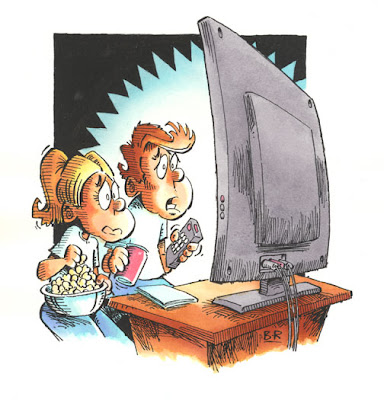
The Dangers of Children and Television


Prolonged sitting should be avoided, say the researchers of a medical study soon to be announced. The researchers, whose work will appear in the Journal of the American College of Cardiology, studied more than 4,500 people 35 or older for four years and found that people who spent more than four hours a day in front of a computer or TV screen were more than twice as likely to have heart problems as people who spent more time in motion. Moderate daily exercise, long thought to be somewhat of an antidote to such sitting-associated dangers, didn't seem to make a difference, the researchers reported.
Further, the study found that people who sit for even two hours at a time can increase their risk of heart problems — the more sitting, the higher the risk.
Sitting for long periods of time at a stretch can hinder the body's ability (through production of an enzyme called lipoprotein lipase) to break down fats, such as cholesterol. So-called "couch potatoes" further complicated their situations by, in many cases, eating high-cholesterol foods while sitting — in effect giving the body more fat to break down but fewer enzymes to do it. The fact that people who watched television were more likely to see ads for junk foods compounded the problem.
This is not the first study of its kind. Scientists have long held that too much inactivity is harmful to the body, for the precise reasons cited in this latest study. However, many researchers had generally believed that exercise done at least once a day could help offset that potential harm. According to this latest study, that exercise makes a difference in overall health but, because it isn't interspersed with the prolonged sitting, doesn't address the inhibition of enzyme production.
The study incorporated sitting only in a leisure context, meaning that participants didn't comment on how much and how long at one time they sat while doing their jobs. In today's increasingly computer-based society, such prolonged on-the-job sitting (even sitting behind the drive while commuting to and from work) could be even more of a danger.
The answer, many researchers would say, is to not let the sitting get too prolonged: break up time spent in front of the computer or TV into smaller segments.
Further, the study found that people who sit for even two hours at a time can increase their risk of heart problems — the more sitting, the higher the risk.
Sitting for long periods of time at a stretch can hinder the body's ability (through production of an enzyme called lipoprotein lipase) to break down fats, such as cholesterol. So-called "couch potatoes" further complicated their situations by, in many cases, eating high-cholesterol foods while sitting — in effect giving the body more fat to break down but fewer enzymes to do it. The fact that people who watched television were more likely to see ads for junk foods compounded the problem.
This is not the first study of its kind. Scientists have long held that too much inactivity is harmful to the body, for the precise reasons cited in this latest study. However, many researchers had generally believed that exercise done at least once a day could help offset that potential harm. According to this latest study, that exercise makes a difference in overall health but, because it isn't interspersed with the prolonged sitting, doesn't address the inhibition of enzyme production.
The study incorporated sitting only in a leisure context, meaning that participants didn't comment on how much and how long at one time they sat while doing their jobs. In today's increasingly computer-based society, such prolonged on-the-job sitting (even sitting behind the drive while commuting to and from work) could be even more of a danger.
The answer, many researchers would say, is to not let the sitting get too prolonged: break up time spent in front of the computer or TV into smaller segments.
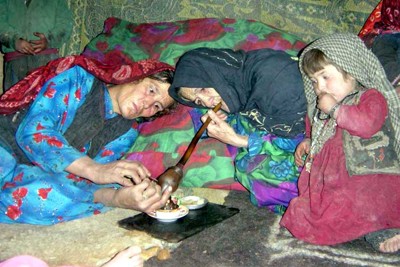
Opium and the effects on children.

http://www.rawa.org/images/opium_women.jpg

http://media.thestar.topscms.com/images/10/5b/8d201a8542228e15fe6df7824931.jpeg

The revelation that the number of opium-addicted Afghan children has reached new highs is a sad unintended consequence of that war. It dramatically illustrates how adult war games can doom generations of children to a miserable life.
A group of researchers hired by the US State Department found staggering levels of opium in Afghan children, some as young as 14 months old, who had been passively exposed by adult drug users in their homes. In 25% of homes where adult addicts lived, children tested showed signs of significant drug exposure, according to the researchers. According to one of the researchers the children exhibit the typical behavior of opium and heroin addicts. If the drug is withdrawn they go through a withdrawal process.
The results of the study should sound an alarm, since not only were opium products found in indoor air samples but also their concentrations were extremely high. This suggests that, as with second-hand cigarette smoke, contaminated indoor air and surfaces pose a serious health risk to women and children’s health.
The extent of health problems in children as a result of such exposure is not known. What is known is that the number of drug users has increased from 920,000 in 2005 to over 1.5 million, according to Zalmai Afzali, the spokesman for the Ministry of Counter-Narcotics (MCN) in Afghanistan. A quarter of those users are thought to be women and children. Afzali stated that Afghanistan could become the world’s top drug-using nation per capita if current trends continue.
According to the UN Office on Drugs and Crime (UNODC) no other country in the world produces as much heroin, opium, and hashish as Afghanistan, a sad distinction for a country already ravaged by war. This may explain why control efforts so far have been concentrated on poppy eradication and interdiction to stem exports with less attention paid to the rising domestic addiction problem, particularly in children.
Both American and Afghan counter narcotic officials have said that such widespread domestic drug addiction is a relatively new problem. Among the factors leading to increased levels of drug use is the high unemployment rate throughout the country, the social upheaval provoked by this war and those that preceded it and the return of refugees from Iran and Pakistan who became addicts while abroad.
Those who are injecting drug users face the additional risk of HIV-infection through the sharing of contaminated syringes. “Drug addiction and HIV/AIDS are, together, Afghanistan’s silent tsunami,” declared Tariq Suliman, director of the Nejat’s rehabilitation center to the UN Office for Humanitarian Affairs. There are about 40 treatment centers for addicts dispersed throughout the country but most are small, poorly staffed and under-resourced.
For the first time ever, an international team including World Health Organization (WHO) officials and experts from Johns Hopkins University and the Medical University of Vienna has joined efforts to design a treatment regime for young children.
The U.S. and its allies have the resources to rapidly expand and adequately fund and resource such treatment and rehabilitation centers throughout the country. Anything less will be yet another serious indictment of an occupation gone astray.
.
Tuesday, December 28, 2010
TSA and the new regulations
In last year's attempted "Christmas bombing," America's Transportation Security Administration implemented new procedures requiring extra screening for people coming from or travelling to fourteen countries. On Friday, Janet Napolitano, America's top homeland security official, announced the end of that policy. The temporary rules that kicked in this January will be replaced with more nuanced rules that utilize real-time, threat-based intelligence along with multiple, random layers of security, both seen and unseen, to more effectively mitigate evolving terrorist threats.
Civil liberties groups had criticized the temporary measures as discriminatory and too broad. But there seemed to be broad consensus that the new measures represented a step in the right direction. "American Muslim organizations, the American Civil Liberties Union, airline and travel industries," and even a Republican senator, Maine's Susan Collins, expressed support for the changes to the Obama administration's policies, the Washington Post reported. To make up an example, that if the National Security Agency picks up chatter that a young man from Yemen who has traveled recently through France plans to crash an airliner, that information, properly vetted and sourced, would be passed along. And individuals who fit that particular category—young men from Yemen who've traveled recently through France—will be subject to any number of secondary security checks, ranging from full-body scans to physical pat-downs to a few individual questions. Even the best conceivable TSA procedures aren't going to catch every potential terrorist. Some of the most important counter-terrorism work happens well before a bomber shows up at the airport.
Single-sex classes
The single-sex format creates opportunities that don't exist in the coed classroom. Teachers can employ strategies in the all-girls classroom, and in the all-boys classroom, which don't work as well (or don't work at all) in the coed classroom. If teachers have appropriate training and professional development, then great things can happen, and often do happen. On this page you can learn about the experience of schools such as Woodward Avenue Elementary in Deland, Florida; Foley Intermediate in Foley, Alabama; Jefferson Middle School in Springfield, Illinois; the Cunningham School for Excellence in Waterloo, Iowa; and many other schools which have seen a dramatic improvement in grades and test scores after adopting single-sex classrooms. But those schools did much more than simply put girls in one room and boys in another. In each of the schools just mentioned, teachers received training from NASSPE in practical gender-specific classroom strategies and best practices for the gender-separate classroom.
The single-sex format creates opportunities that don't exist in the coed classroom. Teachers can employ strategies in the all-girls classroom, and in the all-boys classroom, which don't work as well in the coed classroom. If teachers have appropriate training and professional development, then great things can happen, and often do happen. On this page you can learn about the experience of schools such as Woodward Avenue Elementary in Deland, Florida; Foley Intermediate in Foley, Alabama; Jefferson Middle School in Springfield, Illinois; the Cunningham School for Excellence in Waterloo, Iowa; and many other schools which have seen a dramatic improvement in grades and test scores after adopting single-sex classrooms. But those schools did much more than simply put girls in one room and boys in another. girls in coed classes: 59% scored proficient
.
In June 2005, researchers at Cambridge University released results of a four-year study of gender differences in education. The researchers investigated hundreds of different schools, representing a wide variety of socioeconomic and ethnic backgrounds, seeking to identify strategies which improved performance of both girls and boys while narrowing the gender gap between girls and boys. What makes this study really unique is that the researchers did not merely observe and document what they found; they then intervened, and attempted to graft those strategies onto other, less successful schools. A total of 50 schools were involved either as originator schools (schools which had successfully improved student performance while narrowing the gender gap) or partner schools (less successful schools onto which the "originator" strategies were grafted). One of those strategies was single-sex education. These researchers found that the single-sex classroom format was remarkably effective at boosting boys' performance particularly in English and foreign languages, as well as improving girls' performance in math and science. Most of the studies comparing single-sex education with coeducation focus on grades and test scores as the parameters of interest. Girls in all-girls schools are more likely to study subjects such as advanced math, computer science, and physics. Boys in all-boys schools are more than twice as likely to study subjects such as foreign languages, art, music, and drama. Those boys might not get better grades in those subjects than comparable boys get in more gender-typical subjects. Studies which focus only on grades and test scores won't detect any difference in outcome.
Returning to grades and test scores: There are three categories of evidence:
1. Major nationwide studies- involving tens or hundreds of thousands of students, in countries such as Australia or the United Kingdom where single-sex public education is widely available;
2.Before and after studies- examining a particular school or schools before and after the introduction of single-sex classrooms. Because these studies usually involve no change in resources -- the facilities and student-teacher ratios are the same before and after the switch -- the school serves as its own control;
3. Academic studies- in which investigators study coed and single-sex schools while attempting to control for extraneous variables.
Tuesday, November 23, 2010
Helmets for Safety
Adding the issue to its Most Wanted list,the National Transportation Safety Board (NTSB) has called on all states to adopt laws requiring all motorcycle riders to wear government-approved helmets.The most wanted list is the federal government initiative to encourage state governments to adopt laws and programs the NTSB believes will significantly improve transportation safety.
In its latest annual update of the Most Wanted list, the NTSB added motorcycle safety, while dropping recreational boating safety; an area in which it found substantial progress has been made.
From 1997 through 2008, the number of motorcycle fatalities more than doubled during a period when overall highway fatalities declined. Although the number of motorcycle fatalities fell in 2009, the 4,400 deaths still outnumber those in aviation, rail, marine and pipeline combined, stated the NTSB in a press release.
According to the Department of Transportation (DOT), head injury remains the leading cause of death in motorcycle crashes. As a result, the NTSB recommended that all states require all persons riding on motorcycles - drivers and passengers - to wear helmets that comply with DOT's Federal Motor Vehicle Standard 218.
This standard establishes minimum performance requirements for helmets designed for use by motorcyclists and other motor vehicle users. The purpose of this standard is to reduce deaths and injuries to motorcyclists and other motor vehicle users resulting from head impacts. Currently, 20 states, the District of Columbia and 4 territories have universal helmet laws that apply to all riders. Twenty- seven states and one territory have partial laws that require minors and/or passengers to wear helmets. Three states - Iowa, Illinois and New Hampshire - have no helmet laws. I feel that this is a good law that will protect individuals that ride motor vehicles. This will prevent plenty of head injuries and traumas. Certain federal parties would agree or disagree with these facts. No matter what is said, the law is now that motorists are required to wear helmets.


Friday, November 12, 2010
Tax Cuts in America
Obama said he was committed to working with Democrats and Republicans during the lame duck session to guarantee the extension of middle class tax cuts, but denied that meant he was necessarily willing to cave on the matter of extentding those cuts for wealthy Americans. He says his number one priority is making sure that we make the middle class tax cuts permanent and that we give certainty to the ninety-eight percent of Americans who are affected by those tax breaks. He denied that he will accept extensions of the Bush- era tax cuts. He might be willing to accept the extensions for all tax brackets, not just the middle class.
President Obama proposes to let the Bush tax cuts for the rich expire as a way of saving $700 billion over the next 10 years. He says that our nation cannot afford those cuts, given the unsustainable outlook for the federal budget and the threat it poses to both our short-term and long-term economic health.
But that savings is just a fraction of the $2.2 trillion cost of the generously defined middle-class portions of the Bush tax cuts, which President Obama does want to extend. I think having a tax cut will be a great decision and will result in a better america and better things going on in the near future.We cannot afford to extend the Bush tax cut if we are going through with it. If we did extend the Bush tax cut, we will also have looming deficits. These affects of tax cuts deals with the fact that after the new election, the fact that their are many more Republicans in office means that the tax cuts are more likely to stay.
Subscribe to:
Posts (Atom)